

ViennaUP Report: Day 1
May 17, 2026|IV
Today's stories
- Energy Launchpad is working to position Europe as a leader in the energy transition // By Dennis Miskić
- Sustainable Investing: Regulation is pushing companies to think about sustainability // By Marlene Weissböck
- Startup World Cup Austria: A chance for Austrian startups to reach international investors // By Sophia Tiganas
Energy Launchpad is working to position Europe as a leader in the energy transition
By Dennis Miskić
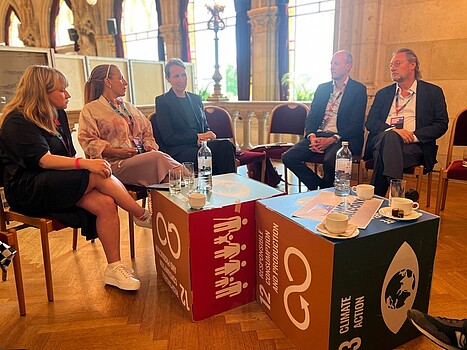
Innovation happens on rooftops, or so they say. So it was only fitting that, during the Energy Launchpad at ViennaUP, experts, academics, entrepreneurs, and investors gathered high above the city to discuss how Europe can transform energy research into scalable startups and spin-offs that strengthen the resilience of critical infrastructure.
When the moderator asked the room who believes Europe can lead the energy transition, almost every hand went up. What followed was a discussion about the work still ahead. Funding gaps, slow commercialization, and a lack of dialogue between academia and industry were recurring themes throughout the panel. Speakers also pointed to the region’s untapped potential. While many of the largest US hyperscalers are concentrated in California, the DACH region rivals Silicon Valley in scale. “We have all these ingredients, but we need to work more closely together and address the scaling gap,” noted Franz Zöchbauer, CEO of Verbund Ventures.
Europe, several speakers argued, has world-class universities, established corporates, and access to capital – yet the three rarely operate in the same room. Bridging that gap is precisely what initiatives like the Energy Launchpad are trying to do.
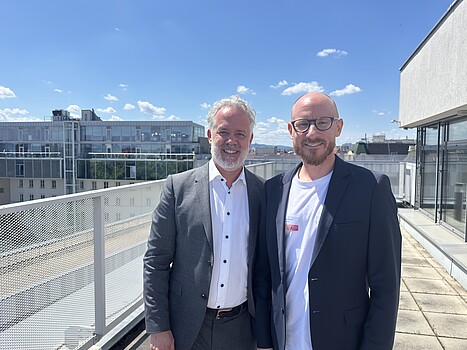
Christian Schaffner, the Executive Director of the Energy Science Center (ESC) at ETH Zurich and René Hofmann, the Head of Institute of Energy Systems and Thermodynamics at TU Wien, gave us more insights.
ViennaUP: The Energy Launchpad is still young – what is it, and what does it offer startups right now?
Christian Schaffner: It brings together academia, corporates, and entrepreneurs from the DACH region and creates a network that enables the development of ideas. We run events like our Summer School in September in Zürich, where young entrepreneurs spend three intensive days with investors, corporates, and facilitators. You can walk up to any participant and get direct access to people who would otherwise take years to reach.
On a scale from one to ten – one being effortless, ten being pushing a rock uphill – how hard is it to put your own ideas into practice?
Christian Schaffner: Getting the Energy Launchpad started was honestly easy – we identified a real need and the interest was immediate. Making it truly successful is harder. Getting startups to actually scale? That's maybe a six, seven, eight. We're working on bringing that number down.
René Hofmann: For me, the Launchpad is an enabling platform – we provide the knowledge base, the topics, the research. The ideas are there. The question is always how quickly and cleanly you can move them out of the lab.
It was mentioned today that a recipe for a successfully scaling an energy startup is to be curious. So, what are you two curious about?
Christian Schaffner: What I’m really curious about is whether my hypothesis is true – that Europe, and especially the DACH region, has much greater potential to produce innovation, innovators, and entrepreneurs in deep tech and other domains. I think this is exactly what we are trying to prove with the Energy Launchpad: that we can create more successful spin-offs and startups in the energy sector.
René Hofmann: As I mentioned earlier, curiosity is what drives researchers. It’s about looking at ideas from a different perspective, trying things in new ways, and seeing them from a new angle. That’s often where new products, business cases, and innovations emerge. It’s really about thinking outside of the box.
Sustainable Investing: Regulation is pushing companies to think about sustainability
By Marlene Weissböck
As part of the Impact Days – one of the events kicking off this year’s ViennaUP festival – speakers at the Building Impact Finance Communities roundtable discussed how to build a stronger impact finance ecosystem. Afterwards, reporter Marlene Sofie Weissböck spoke with Kristin Siegel from Toniic about the EU’s Corporate Sustainability Reporting Directive (CSRD).
ViennaUP: Through the Corporate Sustainability Reporting Directive (CSRD), the European Union aims to make sustainability data more comparable. Is this also changing the culture of investing?
Kristin Siegel: The CSRD is definitely on our minds. Toniic is a network of impact investors that mainly focus on venture capital and private equity. For some of these ventures, the new regulation does not apply because of the companies’ size. But our members also invest in publicly traded companies, and that’s where the CSRD becomes very relevant. We’ve taken a closer look at the directive and how it affects companies. As is often the case with new regulations, there are very good intentions behind it. I think it definitely encourages companies to think about sustainability in ways they hadn’t before. At the same time, especially for smaller companies, the amount of reporting required can become burdensome. However, when it comes to transparency – or simply being able to compare companies in terms of both business performance and impact – it is certainly very helpful.
Are European sustainability regulations seen internationally as more of a model or as a challenge?
Kristin Siegel: I think overall it is probably seen as an example to be followed, because it really put impact in the spotlight. I used to work in a bank, and my colleagues did not think about this aspect at all. Now, with the new regulation, they have been pushed to consider perspectives they haven’t before.
How is the relationship between financial return and societal impact evolving today?
Kristin Siegel: We don’t really have established benchmarks for measuring impact, and traditional benchmarks usually don’t take societal issues into account. That means that if you actively invest in solving social or environmental problems, you often need to commit additional resources, which can reduce short-term financial returns. So the real challenge is: what do you compare these investments to? In many cases, however, the positive societal impact can outweigh the lower financial return, especially when you consider the the negative externalities that conventional investments may create.
What are you personally taking away from today’s discussion?
Kristin Siegel: What I’m taking away from today’s discussion is how inspiring it is to see so many values-aligned actors within the ecosystem. I think strengthening local connections and bringing impact investors together in a meaningful way is incredibly valuable. I really appreciate the shared intention to collaborate, work toward common goals, direct more capital toward impact, and ultimately help solve some of the world’s biggest challenges.
Startup World Cup Austria: A chance for Austrian startups to reach international investors
By Sophia Tiganas
How are today’s ventures of international fame born? To the surprise of almost no one, they start as, well, startups. And for startups to grow, they need one resource above almost all others: investment.
For six years running, Vienna has been providing the stage for Austrian startups to get their shot at exactly that. Organised by invest.austria with the support of Austrian Startups, the Startup World Cup Austria finals give founders the chance to pitch their ideas – and send one of them to the beating heart of the global investment world. The Startup World Cup, organised by Silicon Valley-based VC firm Pegasus Tech Ventures, is one of the most powerful launchpads a startup can find: its Grand Final draws over 3,000 attendees and 500 investors such as Google, Y Combinator, LinkedIn, and Cloudflare – all big names that have backed corporations like Anthropic, OpenAI, and AirBnB.
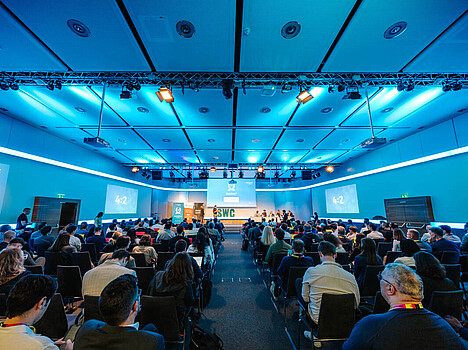
This year, 12 Austrian startups had three (quite intense) minutes to present their pitches in front of an international jury of six: Florian Haas, Xiaomin Mou, Scarlett Sieber, Kenneth Thomas, Werner Müller, and Gregory Gorman. The event was hosted by Daniela Haunstein and Elisabeth van Holthe tot Echten of invest.austria and Austrian Startups, and moderated by Hannah Wundsam, Managing Director of Austrian Startups.
Three minutes to pitch, five minutes for jury questions. The atmosphere was tense, but the founders carried themselves with confidence, and rightly so. The ideas they brought to the stage were anything but small: solutions to the environmental and financial pressures of our time, answers to pressing sustainability challenges, and fresh innovations in HealthTech. Taken together, they painted a picture of a modern startup scene that is paying close attention to what the world actually needs.
What also stood out was the representation on stage and behind the mic. An event of this calibre being hosted and moderated by leading women in investing, entrepreneurship, and technology, with women on the jury as well, felt less like a statement and more like (finally!) an accurate reflection of reality: the startup world is more diverse than it is often given credit for. The founders pitching today made the same point, with their backgrounds being as varied as their ideas. invest.austria Managing Director Daniela Haunstein also showed excitement at how the day was going, stating “I'm very happy with the quality of the pitches. What makes me especially happy is that so many cool women are up on that stage today.“
In an award ceremony opened by Elisabeth Zehetner, the State Secretary of the Ministry of Economy, Energy, and Tourism, it was announced that the startup representing Austria in the Startup World Cup Grand Final in San Francisco will be Factorymaker – a woman-led team developing an adaptive AI-based industrial planning platform that is to enable early simulations, scenario trade-offs, and code-aware checks in the field of building and industrial sites. A community winner was also chosen through a public vote: this award was taken home by the team of Combyn, after their pitch on making cardiovascular health checks more easily available to the public won over the hearts (pun intended) of the audience.
Meet today's ViennaUP reporters
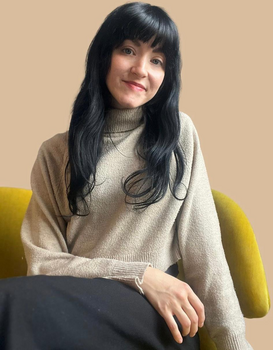
Marlene Sofie Weissböck is a Vienna-based journalist with experience in online reporting, TV, radio, and social media. She has worked for several Austrian media outlets, including PULS 4 and the Austria Presse Agentur, where she reports on political, socio-economic, and economic topics across both broadcast and digital formats.
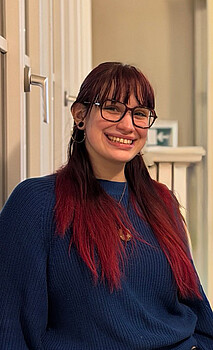
Sophia Tiganas grew up in Romania and moved to Vienna in 2021. Since then, she has worked as a journalist for different Austrian publications and has specialised in Tech, AI, and socio-political topics. She is a fact-checker for the independent media watchblog Kobuk and occasionally covers tech topics for the Austrian newspaper Der Standard.
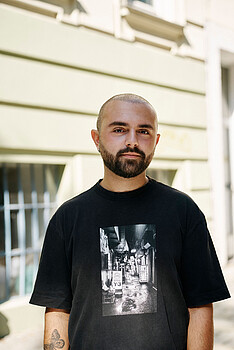
Dennis Miskićis a Vienna-based freelance journalist, mostly covering the Balkans or Eastern Europe. He studied political science in Vienna, Melbourne and Leiden