

ViennaUP Report: Day 3
May 20, 2026|NH
Today's stories
- If your startup were a Balkan mother: Mini-interviews with founders and CEOs at the Recursive CEE Forum // By Dennis Miskić
- Keys to success: What successful founders wish they had done earlier // By Marlene Sophie Weissböck
- Road to Global x Tech Summit – 3 AI tools you can try for yourself at the Tech Summit Expo// By Sophia Tiganas
If your startup were a Balkan mother: Mini-interviews with founders and CEOs at the Recursive CEE Forum
By Dennis Miskić
Startups in the Central Eastern European (CEE) region are increasingly on the radar of many investors, but there is plenty of room to grow. For some, the region may seem too unstable or volatile, or simply out of reach due to a lack of contacts. All the more reason to welcome the spotlight the region received at this year's ViennaUP through the Recursive CEE Forum.
I have roots in Bosnia and Herzegovina and regularly travel the region as a journalist. Thus, I’m well acquainted with the unstable political situations in some countries, human rights concerns, and difficult economic realities — which made it all the more striking to encounter the innovative ideas on display here at ViennaUP, with many of the companies already on their way to the broader European market.
I spoke with several founders and CEOs to find out what their companies do, what their greatest fears are… and what their startups would say if they were typical mamas from the Balkans.
Dénes Kovácsházy (Hungary)— MULTICOM Group. AI-powered tools that support human customer service agents from the back end, helping companies save resources while maintaining the best possible customer experience.
What does your startup do?
Kovácsházy: Our core business is a shared service center, and the startup side is AI solutions. We developed several products for customer service. Our approach says you should start from the back end, not the front line — that way you can reduce the load on human agents while still delivering the best customer experience. Human agents remain the gold standard, but AI can support them effectively.
What was the scariest thing about building your startup?
Kovácsházy: The question of how big the hype really is. Will the startup take off? What will the real traction look like, and what is just noise?
***
Miloṡ Jovanović (Serbia) — Kampster AI An online portal that helps companies transform their existing knowledge into structured documentation, then delivers personalized learning courses to each user.
If your startup were a Balkan mother, what would she say every day?
Jovanović: Learn, son, learn — it will be worth it.
What was the scariest thing about building your startup?
Jovanović: Not knowing what's coming tomorrow. You could be a millionaire, or you could disappear.
How is it going so far?
Jovanović: We're doing well. We're happy, and we're here at ViennaUP to find partners for global expansion.
***
Tanja Savić (Serbia) — Negotiate Wind A mobile application based in Prague that brings a deal-room experience to football transfer negotiations.
What was the scariest thing about building your startup?
Savić: Whether our product would be a market fit. That's something we still think about today.
How is it going so far?
Savić: It's going. We're pivoting, listening more closely to our users, and implementing their needs.
***
Nikola Milanović (Serbia) — WellPet.ai A platform built by dog lovers to help owners better understand and respond to their dogs' feelings and needs.
If your startup were a Balkan mother, what would she say every day?
Milanović: You need to care about your furry friends and understand their words. It's not just woof-woof — it's about understanding their feelings.
What was the scariest thing about building your startup?
Milanović: One day we will be able to fully understand a dog's messages. That could be scary for some people — but that's the goal.
***
Sreten Komlenović (Serbia) — Diratech AI-powered X-ray technology for the food production industry.
What was the scariest thing about building your startup?
Komlenović: Probably what most deep-tech founders face: the unpredictability and complexity of scaling from Serbia.
How is it going so far?
Komlenović: We have initial customers and have started scaling internationally, with one cooperation in Slovenia and several discussions underway with OEM machine builders across the EU. There's a lot of traction coming our way.
If your startup were a Balkan mother, what would she say every day?
Komlenović: (laughs) That’s a bit hard to answer. I have something different. During a school visit to our Belgrade office, we explained what we do to the children. One little girl said: "Just keep going." That's what we use now.
***
Kristine Vinkle (Latvia) — Skilloom An AI agent-based platform that identifies skills gaps, tests users, and maps out personalised micro-learning plans to help them reach their target knowledge level.
What was the scariest thing about building your startup?
Vinkle: Whether it was the right idea and whether the market would accept it. Over time I realised you just have to stay open-minded and flexible — listen to people and really hear them. That gives you a feel for the best way to approach the market.
How would you describe your idea to schoolchildren?
Vinkle: Imagine you want to become president but have no idea what steps to take to get there. Our solution maps out exactly those steps — then helps you assess yourself and train to get there.
Keys to success: What successful founders wish they had done earlier
By Marlene Sophie Weissböck
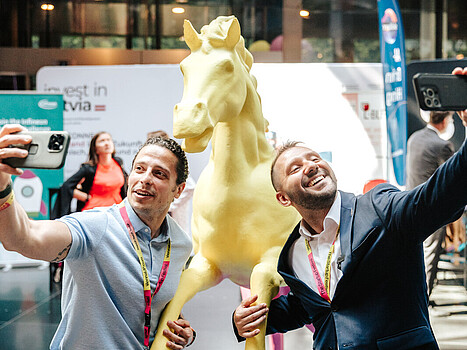
The path to entrepreneurial breakthrough is tough. Founders often describe the early stages in particular as a journey full of obstacles – and learning. Several iconic founders didn’t find success until their second or third venture: Reid Hoffman of LinkedIn fame had a startup you’ve never heard of called SocialNet; Travis Kalanick of Uber used to have a company called Scour. At ViennaUP, founders both new and experienced are roaming throughout the city. We asked a few what they wished they had known sooner.
1. Fall in love with the problem, not your solution
One of the most common lessons is to start with the problem space, not a fixed idea. Sustainable innovation comes from deeply understanding real-world needs before building anything. As Alfredo Arreba (Founder at Epona AI Labs) notes, “spending the first months validating assumptions, researching the market, and talking to real stakeholders is essential”. By exploring the problem space first, better and more relevant solutions tend to emerge naturally over time.
2. Know your ecosystem
Many founders pointed out that a lack of knowledge about the local startup ecosystem leads to avoidable delays. This includes missing out on funding opportunities, accelerator programs, mentorship, and relevant networks that could significantly accelerate early growth.
3. Don’t ignore the money on the table
In Austria, institutions like WKO, AWS, and FFG offer grants, support programs, and advisory services. However, many founders discover these resources too late. Early awareness can significantly reduce financial and operational pressure.
4. Build the product before the paperwork
Many founders focus too early on legal setup and company structure instead of validating their product first. As Konstantin Bezuhnov (Evrotrust) notes: “Building for a year without proper validation and focusing too much on technical development was one of the biggest early mistakes.”
5. Execution beats planning
Execution matters more than perfect preparation. Rather than spending too much time on detailed planning, founders should create prototypes quickly, test assumptions, and iterate based on feedback. Real learning happens through action.
6. Make yourself the first test subject
Some founders emphasize the value of direct, personal experimentation. Emily Genatowski, an experimental AI robotics founder, explains her approach: “I turned my home into a laboratory and myself into the test subject. I welcomed failure, pain points, and challenges to gain firsthand insight into real-world practicality.”

Road to Global x Tech Summit – 3 AI tools you can try for yourself at the Tech Summit Expo
By Sophia Tiganas
Whether you're an investor, a corporate, a startup founder, or just a passionate tech enthusiast – everyone loves a good test-drive. Especially when you want to go beyond the pitches and get hands-on with the actual technology being built. And sometimes, a busy networking session just doesn't give you the time or headspace to really dig in.
That's exactly what the Tech Summit Expo at this year's Road to Global x Tech Summit is for. The two-day event – which you can still catch on Thursday – isn't just keynotes, panels, and speeches. A selection of startups have set up stands for you to meet them up close: ask the questions you actually want answered, see the product in action, and in some cases, try it yourself.
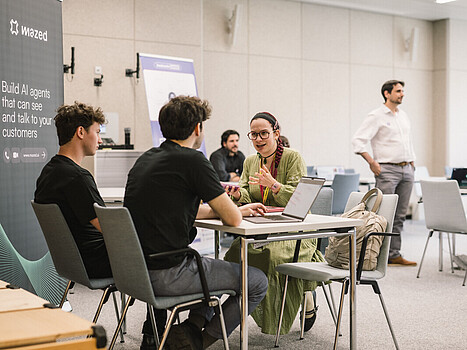
The startups here span everything from AI and marketing to global security – and they're not just ready to pitch, but to let you experience exactly what they promise their customers. The ViennaUP reporting team spent time on the expo floor today, talking to founders who are beyond excited to be here and eager to get into the details. Below are three who went one step further and let us try out their tech first hand.
1. autobotAI
Cybersecurity tends to conjure images of large teams, complex infrastructure, and serious budgets. autobotAI – a woman-led startup from India – is out to change that. Their platform makes reliable cybersecurity accessible to any company, regardless of the time or resources available, through an intuitive drag-and-drop AI agent builder that walks users through every step of the process. And you don't need to start from scratch: a built-in library of pre-existing workflows lets you browse, pick a template that fits your use case, import it, tweak as needed, and hit publish. It's powerful stuff – without the steep learning curve.
2. telefonagent
Founded and led by two students based in Vienna, telefonagent tackles a frustration that every renter knows too well. A pipe bursts on a Friday evening – and suddenly you're facing an entire weekend with no way to reach your property management. telefonagent's AI agent bridges exactly that gap, keeping communication open outside of business hours when it matters most. To give us a real feel for the product, we even called a test agent that's already in use – and what we experienced was, no matter how sceptical you might be when it comes to AI customer support, an incredibly competent assistant: able to distinguish between a minor inconvenience and a real emergency, and with the ability to immediately connect the caller with whatever help they might need. Imagine a future without leaky faucets over the holidays: a dream for renter and building managers alike.
3. mazed.ai
Speaking of customer support, here's another scenario all know too well: a chatbot that goes in circles, a call centre that puts you on hold, a tech support line that leaves you more confused than before. mazed.ai is built for exactly those moments – their AI agent can see your screen as you talk to it, just like in a video call, and guides you directly to where you need to go using a node system customised to each of their clients. Based on our test run with it, no tab is too hidden and no step too confusing to follow: less explaining, less frustration, and actually getting somewhere.
Meet today's ViennaUP reporters
Dennis Miskićis a Vienna-based freelance journalist, mostly covering the Balkans or Eastern Europe. He studied political science in Vienna, Melbourne and Leiden
Marlene Sofie Weissböck is a Vienna-based journalist with experience in online reporting, TV, radio, and social media. She has worked for several Austrian media outlets, including PULS 4 and the Austria Presse Agentur, where she reports on political, socio-economic, and economic topics across both broadcast and digital formats.
Sophia Tiganas grew up in Romania and moved to Vienna in 2021. Since then, she has worked as a journalist for different Austrian publications and has specialised in Tech, AI, and socio-political topics. She is a fact-checker for the independent media watchblog Kobuk and occasionally covers tech topics for the Austrian newspaper Der Standard.
The opinions expressed in the ViennaUP daily reports are those of the authors and their interview partners and may not reflect those of the ViennaUP team.