

ViennaUP Report: Day 2
May 19, 2026|NH
Today's stories
- Pitch perfect – the 7 things investors really want to hear // By Sophia Tiganas
- The toxic optimist: AI platform founder Alexei Lazarov on European tech sovereignty // An interview with Dennis Miskić
- Female Founders and Investors in the Spotlight: Women Power at ViennaUP // By Marlene Sophie Weissböck
Pitch perfect – the 7 things investors really want to hear
By Sophia Tiganas
So you've got an amazing idea, an incredibly capable team, and the solution to a problem that you understand better than anyone. Your startup – you're pretty sure – is going to make it big. But first, there's that one tiny problem: money. And if you need money, you need investors.
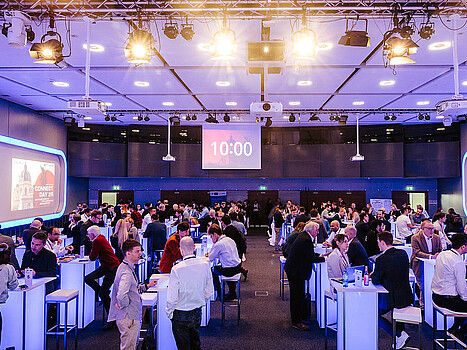
ViennaUP's Connect Day is one sure way to get in touch with the big players ready to take a bet on you. There are reverse corporate pitches, 1:1 matchmaking through a speed-dating format, and even a dedicated pitch room. It's the type of event where you come prepared and leave successful. But wait – have you already made your pitch… perfect?
We chatted with some investors at this year's Connect Day and asked them the one question you should be asking yourself while preparing your pitch: what do they really want to hear?
1. Know your focus
It's perfectly normal for your head to be filled to the brim with ideas for your startup – you're passionate about it, after all. But according to Tereza Trifonova, CEO of Serdica Capital in Bulgaria, passion without focus won't get you far. When you're pitching, skip the fun facts and show that you know your market inside out. You don't have time to think out loud in front of a room full of investors: leave out the maybes and stick with the certainties.
2. K.I.S.S.-es for everyone
You've probably heard it a million times already, but Keep It Simple, Stupid (K.I.S.S.) will forever be the holy grail of pitching. Patrick Cesky, CEO of the aws Startup-Fund, puts it plainly: you only have a couple of minutes to make your idea click – not just for the specialists in the room, but for everyone in it. If they have to work hard to understand you, you've already lost them.
3. Cut to the chase
Every second of your pitch counts. Christoph Teufel, founder and Managing Director at the moonlander Group, is straightforward about it: don't waste time on embellishments. Tell the audience – and hopefully your future investors – what your startup does, what you need, and what your long-term plan is. That's it.
4. Know your edge
What can you promise your customers that no one else can? Peter Buchinger, Investment Associate at TecNet, says that a strong value proposition not only identifies the problem at hand, but also makes it unmistakably clear how you stand apart from your competitors. Don't leave this to inference – spell it out.
5. Structure is everything
A brilliant idea poorly explained is still a missed opportunity. Lekha Ehrenhöfler-Thailayil, Senior Investment Manager at Karriere.at, recommends sticking to a structure that makes it impossible to miss what the core problem is, why it matters, and exactly how you plan to solve it.
6. Lead with your "why"
Your product is worth knowing about – but investors need to understand the conviction behind it. Alice Freudenthaler from the Plug and Play Tech Center wants to know why your team is doing this, what drives you, and what makes you the right people to see it through. The "why" is often what separates a memorable pitch from a forgettable one.
7. Don't leave without asking
Last but certainly not least: leave the stage having given your future investors something that sticks. They know you exist now – great. But what do you actually want from them? Edgar Müller from Mitten im Neu GmbH says that a clear call to action is one of the most commonly forgotten elements of a pitch – and one of the most decisive.
So take the advice: if you've found this helpful, don't forget to join us at more ViennaUP events throughout the week!
The toxic optimist: AI platform founder Alexei Lazarov on European tech sovereignty
By Dennis Miskić
Reading and hearing about AI can lead to a gloomy outlook on the world. Who could blame you? With AI, nobody tells you to read the package leaflet for risks and side effects.
Anything new by default can be scary. The Human x AI conference explored the reasons for those fears – and shone a light on potential paths forward. Not a moment too soon. New AI innovations are springing out of the ground like mushrooms after rain. These innovations are driving a massive surge in data centre electricity demand on an ever-warming planet, and more and more jobs seem at risk. The Chinese, for example, reportedly claim that they can replace 60% of the labour force that they would otherwise lose to population aging by 2035.
But such projections are always to be taken with a grain of salt: panellist and political scientist Ivan Krastev reminded the audience that in 1900, there were as many people living in Vienna as there are today – and the city’s continued growth seem assured. Projections and forecasts can be taken as a way to orient oneself toward the future, but they are not to be taken fully at face value.
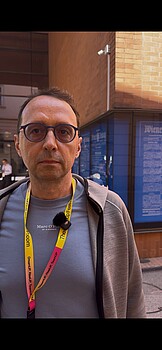
ViennaUP reporter Dennis Miskic talked to Alexei Lazarov, who moderated the first two panels of the day. Lazarov is the founder and CEO of Visibilio AI, a Sofia-based AI visibility platform who previously worked as a senior journalist for the Bulgarian business weekly Capital, where he held every seat in the newsroom from reporter to editor to editor-in-chief.
ViennaUP: If, as Ivan Krastev said during your panel, optimism can be as toxic as pessimism, what are you?
Alexei Lazarov: I'm a toxic optimist.
ViennaUP: You moderated the first two panels of the HumanXAI. Could you give a quick recap of what was talked about today?
Lazarov: We wanted to discuss the question of European sovereignty. What Europe should do in order to preserve itself. To view this question more from a bird’s-eye view, a high orbit point of view. Because usually we are more focused on details. This time, we wanted to give a bird’s eye picture of what's going on in the world and how Europe should react to it.
ViennaUP: What do you think will change for Europe’s democracies?
Lazarov: Europe is in a difficult crossroads because it is pushed in between different crises and superpowers. On the one hand, China is trying to prove that a market economy is not a good thing and a state-planning economy is better. Russia, on the other hand, is trying to prove that democracy is not so effective as autocracy. The U.S. is trying to create a new model in which the tech sector is converging with politics and state. And Europe is staying in the middle in this particular situation. And this is a very hard position because Europe is defined by very clear principles like freedom, market economy and democracy. And when these pillars are being questioned, it's a very hard place to be.
ViennaUP: Some of these terms are recurring everywhere. What about Europe's sovereignty and autonomy?
Lazarov: Europe should push towards sovereignty and autonomy as fast as it can. Because right now, either we are going to be autonomous, or we are going to be subject to non-democratic superpowers. And that's a very difficult situation to be in. A very unpleasant one as well. The question of European freedom – whether we should as Europeans preserve our freedom – lays on the foundation of whether we should have technical and economic autonomy.
ViennaUP: Maybe in simple terms, what would that look like, being sovereign and autonomous?
Lazarov: The sovereignty lays on a few very well-defined pillars. For instance, if you want to preserve our physical freedom and borders, we have to have a strong military. But in order to have a strong military, we need to have a very well-developed software computer sector. But in order to have a very good computer sector with a very well-developed AI, you also have to have a very well-developed energy sector. You need autonomous energy. In Europe specifically, this is the renewable sector. This is the only sector that could be autonomous for Europe. In order to have energy and drive some sort of defense innovation sector, you need to have very good financing. These four pillars – financing, compute and AI, defense and energy – are, I believe, the most important ones for European sovereignty.
Female Founders and Investors in the Spotlight: Women Power at ViennaUP
By Marlene Sophie Weissböck
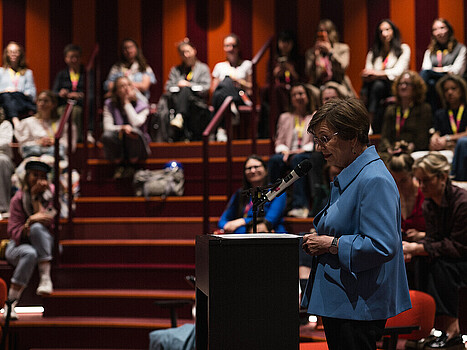
From the very beginning, it was clear that ViennaUP’s Female Founder Experience was not a typical startup event. The session opened with the Eurovision Song Contest’s winning tune, Bangaranga, featuring a dance session that include Austria’s First Lady, Doris Schmidauer.
Female founders and investors took centre stage and brought fresh energy to women-only event, which focused on female entrepreneurship. Judith Williams, Diana zur Löwen, and Katharina Schneider are well-known figures who reflect the growing visibility of women in the entrepreneurial and investor landscape. Their appearances on Austrian and German TV shows like “2 Minuten, 2 Millionen” and “Die Höhle der Löwen” (versions of “Shark Tank”) demonstrate what women with ambition can achieve. Here, they moved from the screen to real life. The focus was not on staging or spectacle, but on authentic conversations about women in business and the challenges they face.
“I’ve experienced being the only woman in the room,” said Gabriele Tatzberger, Director of Founders and Startups at the Vienna Business Agency. “When CEOs are introduced, and you’re singled out as the only woman, you can feel the irritation all around.”
A recurring theme throughout the day was the importance of female spaces. One participant, a founder in food and biotech with 20 years of experience, told ViennaUP: “When women support each other, it creates stronger economic opportunities and helps address shared challenges like family planning — that’s why women-only spaces and opportunities matter.”
Founders also highlighted structural barriers in their conversation with this ViennaUP reporter: participant Mariliis Mia Topp spoke about the difficult transition from academia into the startup world, especially regarding access to capital and networks. Event participant Petra Cihlarova added: “Female-led startups are visible but still underrepresented in key investment contexts.”
In the end, the message is clear: this is not about individual cases, but about structures. Equality is not just a buzzword, but a process. Or, as one event participant put it: “It’s about creating protected spaces for exchange, learning, and mutual support among women.”
At the end of the day, women are essential to solving transnational challenges. “Starting a business is not a small thing and as a woman, it’s even harder,” said First Lady Doris Schmidauer. “Look around: the climate emergency, a shifting world order, Europe’s economic crisis, and the challenge of AI. These problems won’t solve themselves. They need problem solvers — and they’re right here.”
Meet today's ViennaUP reporters
Sophia Tiganas grew up in Romania and moved to Vienna in 2021. Since then, she has worked as a journalist for different Austrian publications and has specialised in Tech, AI, and socio-political topics. She is a fact-checker for the independent media watchblog Kobuk and occasionally covers tech topics for the Austrian newspaper Der Standard.
Dennis Miskićis a Vienna-based freelance journalist, mostly covering the Balkans or Eastern Europe. He studied political science in Vienna, Melbourne and Leiden
Marlene Sofie Weissböck is a Vienna-based journalist with experience in online reporting, TV, radio, and social media. She has worked for several Austrian media outlets, including PULS 4 and the Austria Presse Agentur, where she reports on political, socio-economic, and economic topics across both broadcast and digital formats.
The opinions expressed in the ViennaUP daily reports are those of the authors and their interview partners and may not reflect those of the ViennaUP team.