

ViennaUP Report: Day 4
May 21, 2026|NH
Today's stories
- Inside this year’s InsideOut Summit – Professionalism with a side of LEGOs// By Sophia Tiganas
- What to keep in mind when expanding your business to Vienna // By Dennis Miskić
- Climate Crisis: Is AI the villain, superhero or just “a boring chair somewhere in the room”? // By Marlene Sophie Weissböck
Inside this year’s InsideOut Summit – Professionalism with a side of LEGOs
By Sophia Tiganas
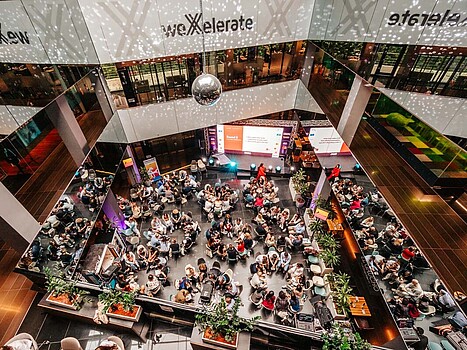
Anyone who still pictures networking, startup pitches, and general business talk as bland office events full of suits should take one look at this year's InsideOut Summit at the weXelerate space.
Lively co-working spaces, innovative ways to network (including literal LEGOs!), and a gigantic disco ball set the atmosphere for a day full of energy and connection – with over 300 founders, investors, and innovation leaders in attendance. Not just to network, though. InsideOut is all about centring the people behind the businesses.
While the world races towards innovation at all costs, InsideOut focuses on less known numbers: according to the summit's organisers, over 70% of all innovators face mental health challenges. Because as we all sprint towards making the world a better place, quite a few of us forget about ourselves – but as InsideOut puts it, you can't build the future without upgrading the builders.
With panels, keynotes, and creative new ways to meet new people, InsideOut puts the humans behind the projects in the spotlight – and allows them to be people before being professionals. That way, new business collaborations and connections can be built not just on practicality, but on genuine human connection.
A personal highlight for many participants was – probably not all that shockingly – the LEGO networking session. Apparently, nothing makes people open up and get comfortable around each other quite like some good old building blocks. Especially when a beloved childhood pastime can help answer some genuinely tough questions: How would you solve one of the world's biggest problems if you had a superpower? What part of your childhood do you still carry with you today? What would your future self thank you for?
After using the colourful blocks to find their answers and share the stories behind their spontaneous creations, many participants didn't just go their separate ways: the conversations sparked by something that might have seemed a little silly at first spilled well beyond the session itself, with groups staying together and chatting all through their lunch break.
It turns out that networking and professionalism aren't hindered by being a real human being with a history, wishes, and fears. Quite the contrary: InsideOut seems to have found the key to creating connections that actually last.
What to Keep in Mind When Expanding Your Business to Vienna
By Dennis Miskić
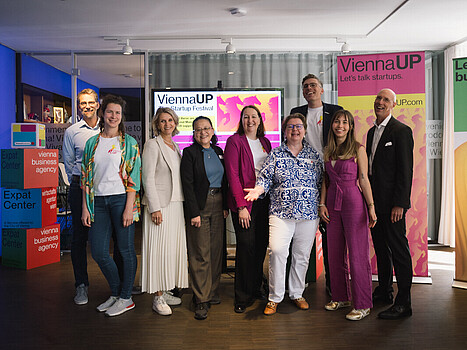
At this year's ViennaUP, international companies had to opportunity to sit down at the Vienna Business Agency’s Expat Center and share their experiences of what setting up in the Austrian capital actually looks like.
Vienna makes a compelling case on paper: a central European location, a stable regulatory environment, consistently high quality of life. Vienna's reputation as one of the world's most livable cities is a practical asset when it comes to attracting international talent. Being from Vienna myself, I think that reputation is well-earned. It's the kind of city where the quality of everyday life is easy to take for granted until you try living somewhere else.
But how does the on-paper case for Vienna translate once you're actually registering a company, hiring staff, and trying to turn a market opportunity into a functioning business? At the session Best practices for expanding your business to Vienna held this week, founders from across industries — crypto, consumer tech, biotech, retail — compared notes on how they settled in. A few themes kept coming up.
1. Consumer demand is there, and so are market opportunities
Austrian consumers are quality-conscious and willing to spend. What several founders noticed, though, was not just that the market exists, but that it's underdeveloped in specific segments. Vienna tends to lag behind comparable European cities when it comes to some innovative concepts reaching the market. For the right business idea, that's less of a warning sign and more of an opening.
2. Location pays off in practice, not just in pitch decks
The "heart of Europe" framing gets used a lot. But founders at the session described real, measurable logistics and connectivity advantages. Those can range from supply chain timelines to ease of travel across the continent.
3. Bureaucracy is boring but it rewards patience and preparation
Austria’s famed bureaucracy and its regulations take a while to figure out, especially for international founders. When it comes to funding, it is important to have a good network. Programs exist, but they come with specific eligibility criteria that don't always accommodate businesses that don't fit a standard profile. Going in with enthusiasm alone may not do it, while realistic timelines and a willingness to adapt your approach will pay off in the end.
4. Build your local network before you need it
Across the board, founders credited informal networks — other entrepreneurs, university contacts, industry peers — as essential to actually getting things done. The written rules tell you what's required. People who've already been through the process tell you how it actually works. Start building those connections early.
5. You can actually reach humans at institutions
It came up repeatedly, almost as an aside: in Vienna, institutions tend to respond. Calls get returned. Questions get answered. For founders used to slower or more opaque systems elsewhere, this turned out to be a meaningful practical advantage in the early stages of setup.
The session reminded entrepreneurs that relocating to a new city is never easy (duh). But between horror stories of failed business expansions and the in-your-dreams-only smooth sailing of imagination, Vienna turns out to be worth it. And the Vienna Business Agency, which organized the event around speakers whose companies they helped to resettle or set up in Vienna, is there to help every step of the way.
Climate Crisis: Is AI the villain, superhero or just “a boring chair somewhere in the room”?
By Marlene Sofie Weissböck
During ViennaUP, the whole city of Vienna becomes an international meeting point for founders, investors and tech experts. One topic in particular is polarising discussions: what role will artificial intelligence play in the future of business and the climate? And how sustainable is AI really?
Reporter Marlene Sofie Weissböck spoke with Ana Simic, an AI transformation consultant specializing in business model innovation, about AI myths and widely discussed dystopian narratives. For Simic, the debate is often framed in overly extreme terms. „If the climate crisis were an AI horror movie,” she said on the sidelines of the ViennaUP event Smart City Summit 2026, “AI would probably be neither the villain nor the superhero — maybe more like a boring chair somewhere in the room.”
At first, the comparison sounds surprising, but it actually describes her view of the technology quite accurately:“ We tend to either glorify or demonise this technology far too much, and in my opinion we really need a much more sober perspective,” says the AI transformation consultant.
Especially in the context of the sustainability debate, she considers exaggerated portrayals of AI’s climate impact problematic. Artificial intelligence does require energy-intensive infrastructure — from data centres to computationally heavy applications — but this must be considered in an overall balance that also includes potential efficiency gains.
She rejects a blanket classification of AI as harmful to the climate: “There will be cases where an AI use case doesn’t make sense because of the additional energy consumption,” she says. “But there are just as many areas where AI can help make complex relationships visible that humans can hardly oversee on their own anymore.”
Simic does not see the real danger in the technology itself, but in how it is being conceptualised. “Many organizations are still stuck in individual pilots and isolated use cases, while what’s really missing is systemic thinking and the connection between different departments,” she notes.
At the same time, discussions around AI often swing to extremes: total automation or complete ineffectiveness. “In reality, we don’t yet know what these technologies will be capable of in a few years.”
Another misconception is the assumption that AI can compensate for poor data or a lack of collaboration. “Without good data and without connected people, even the best AI won’t get us very far.”
Despite the ongoing hype around artificial intelligence, Simic’s message at ViennaUP remains sober: less panic, less utopia and significantly more systemic thinking about where AI can actually make a difference. Or, in her words: “A slightly more grounded perspective on all this would already do everyone good.”
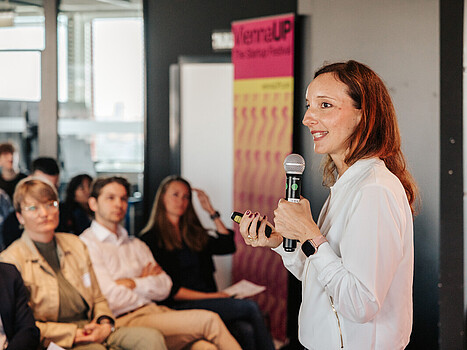
Meet today's ViennaUP reporters
Sophia Tiganas grew up in Romania and moved to Vienna in 2021. Since then, she has worked as a journalist for different Austrian publications and has specialised in Tech, AI, and socio-political topics. She is a fact-checker for the independent media watchblog Kobuk and occasionally covers tech topics for the Austrian newspaper Der Standard.
Dennis Miskićis a Vienna-based freelance journalist, mostly covering the Balkans or Eastern Europe. He studied political science in Vienna, Melbourne and Leiden
Marlene Sofie Weissböck is a Vienna-based journalist with experience in online reporting, TV, radio, and social media. She has worked for several Austrian media outlets, including PULS 4 and the Austria Presse Agentur, where she reports on political, socio-economic, and economic topics across both broadcast and digital formats.
The opinions expressed in the ViennaUP daily reports are those of the authors and their interview partners and may not reflect those of the ViennaUP team.