

ViennaUP Report: From the Weekend
May 17, 2026|NH
Today's stories
- “Results that we will be able to use straight away”: 48 hours at the Europe Tech Hackathon // By Sophia Tiganas
- Startup Interview: How BloomNow wants to make neurodiversity easier to understand // By Dennis Miskić
“Results that we will be able to use straight away”: 48 hours, 15 teams, 2 challenges at this year's Europe Tech Hackathon
By Sophia Tiganas
A bunch of programmers spending the weekend working on seemingly abstract and hard-to-understand IT solutions – what does that have to do with our current reality? You might question the sense of it. And that is where you'd be indescribably wrong. Because this year's hackathon – organised by Sustainista – came through with two tasks that aren't just play-tests for participants to have some fun and then go home: they're challenges based on current EU regulations, real issues companies already face, and the search for implementations that can be put into action ASAP.
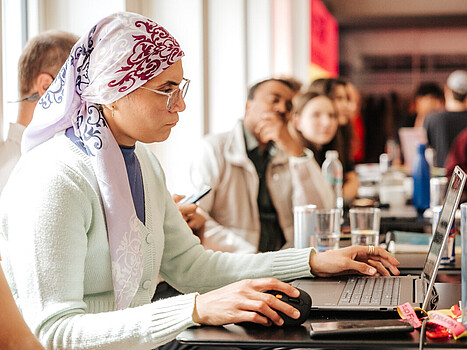
The atmosphere at the ÖBB Open Innovation Factory – the host of this year's Europe Tech Hackathon – was electric from start to finish. The opening keynote speeches from experts in the fields of business startups, AI, and IT, as well as from members of the jury who would rate the participants' projects by Sunday, inspired teams to find each other and excitement to bubble up around the challenges being faced.
The first hackathon challenge – an AI-based quality control of building sites for fibre-optic infrastructure – is a real problem that öGIG (in English: Austrian Glass-Fiber Infrastructure Association), the company responsible for fibre-optic roll-out in Austria, is facing right now. This announcement by judge Martin Fuhrmann made the room buzz with anticipation: the winning team wasn’t solving some pretend challenge; they would be helping to solve a current issue.
While the participants were hard at work on the second day of the hackathon, Fuhrmann was already beaming with excitement: “From what I've seen so far, they are producing results that we will be able to use straight away. That's brilliant for us at öGIG: it shows everyone in the company that a setup like this really does deliver results and produces models that actually make a difference.”
The second challenge was to integrate the European Digital Product Passport into a functional ERP system. Those participants with experience in business management software were thrilled about this. One team even stated, “Maybe the biggest issue was finding a team name. Everything else? We've got it in the bag.” Mind you, this team did end up winning this challenge’s grand prize.
From Friday afternoon all the way to Sunday morning – when all teams had to pitch their projects to the jury of experts – the atmosphere never failed to be vibrant. Of course, the nerves were there, but overall, the participants were far more excited, confident, and curious than anxious.
The winners were announced on Sunday after thorough deliberation by the jury based on each team's pitch – and believe us, it was not an easy choice to make. Especially since there were not only two winning teams: rewards were also given for team spirit, technical implementation, and project scalability. Still, Veloport (in the DPP-ERP challenge) and Third Eye (in the AI quality check challenge) took home the big prizes – with innovations that focus on sustainability and practicality, and that, as one of the judges put it, didn't just fulfil the criteria, but rather completely surpassed all expectations.
Winning teams:
Best technical implementation – Trench Net
Best team spirit award – OhSome Compliance
Best European Idea Award – Solar Passport
Grand prize 1st challenge – Veloport
Grand prize 2nd challenge – Third Eye
Startup Interview: How BloomNow wants to make neurodiversity easier to understand
By Dennis Miskić
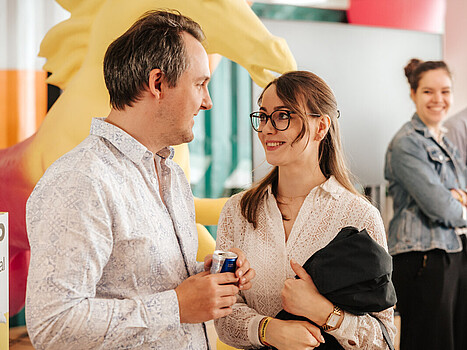
BloomNow is building a platform to support neurodivergent children – an idea that stood out to ViennaUP reporter Dennis Miskić because it is made by people who live the experience they are hoping to support. On the sidelines of Startup Live at ViennaUP, he spoke with founder Anna Christine Enzinger and psychotherapist Miriam Stammberger about their startup, community exchange and why lived experience matters.
ViennaUP: How would you describe BloomNow to someone who doesn’t understand what neurodivergent means?
Anna Christine Enzinger: BloomNow is a consumer platform for people who support neurodivergent children. That can mean parents, teachers, kindergarten educators, carers, grandparents, therapists or other professionals. The first step is a short “smart intake” with eleven questions. It is not a diagnosis. It simply gives people a first orientation: could it make sense to look more closely into ADHD, autism, dyslexia or another form of neurodivergence? We are careful with labels. We don’t want people to immediately think: “This child has ADHD” or “This child is autistic.” We first want to explain what different brain types can mean and what kind of support might help.
If BloomNow were a dish, what would it be?
Anna Christine Enzinger: A pho bowl. It is warm, nourishing and has many different ingredients. You can choose what fits you and what helps you.
Miriam Stammberger: Or maybe a pizza where every slice has a different topping.
You say that the app is “built by people who live this”. What does that mean?
Miriam Stammberger: I’m a psychotherapist with my own office. I’m neurodivergent myself, have two kids who are neurodivergent with a husband who is as well. And that is so essential. Even for me, as a psychotherapist. Children who aren’t left alone, who are constantly criticized, who are judged negatively, and who receive incorrect diagnoses – many neurodivergent children end up being prescribed the wrong medications.
Anna Christine Enzinger: Many people in the team are neurodivergent or have neurodivergent people very close to them. That creates a different kind of understanding. It also gives you energy. If you do not really care about this topic, you probably run out of breath very quickly. For investors, that matters too. They can feel whether a team is truly passionate about what they’re doing.
You also mentioned a community element where people can exchange experiences or questions. How does that work?
Anna Christine Enzinger: There’s a community for different groups – for parents, educators, experts, whatever the case may be. It’s structured a bit like Reddit, in the sense that you can subscribe to the ADHD group, the Meltdowns group, or whichever group interests you, as well as the parents’ group or the experts’ group, whatever the case may be. And then you see these posts in your feed and can post there yourself. I’m dealing with this and that issue at home – what can I do? And then you might even get feedback from other parents. Which helps, on the one hand, when you’re a parent of newly divergent children and get a lot of negative feedback from the outside. Something like, well, just hold their hand when a child isn’t sleeping well. You don’t have to lie down next to them. So, that type of uncoalesced opinion where you end up feeling bad about the mistakes you make yourself.
Then people quickly go into isolation because they don’t realize that there are actually tons of people out there who go through the same thing. But being heard by other people who understand your struggles and say: ‘This is tough right now. But here is what helped me in a similar situation’ is so valuable.
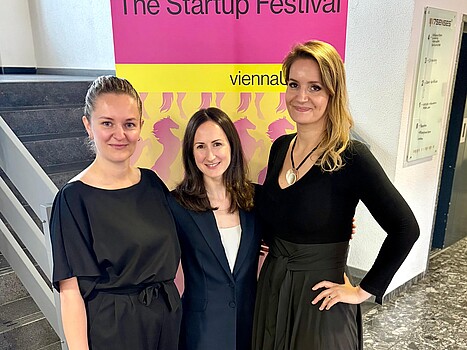
Meet today's ViennaUP reporters
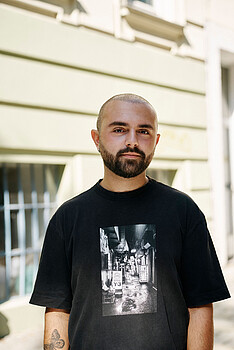
Sophia Tiganas grew up in Romania and moved to Vienna in 2021. Since then, she has worked as a journalist for different Austrian publications and has specialised in Tech, AI, and socio-political topics. She is a fact-checker for the independent media watchblog Kobuk and occasionally covers tech topics for the Austrian newspaper Der Standard.
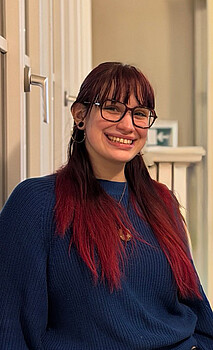
Dennis Miskić is a Vienna-based freelance journalist, mostly covering the Balkans or Eastern Europe. He studied political science in Vienna, Melbourne and Leiden